The Irony of Misplaced Dualism: The Asinine Attempt to Separate the Mādhvas and Gauḍīyas Over Lord Baladeva

Modern-day discourse between Mādhvas and Gauḍīya is often marred by unnecessary friction due to superficial readings of core texts. A prime example is a persistent misunderstanding shared by less well-read members of both the Tattva-vādī (Mādhva) and Gauḍīya Vaiṣṇava communities regarding the ontological status of Baladeva Prabhu.
A common narrative claims that Śrī Madhvācārya categorizes Baladeva simply as a jīva (an individual soul), which is in direct contradiction with the Gauḍīya understanding of Baladeva as Kṛṣṇa’s vaibhava-prakāśa—the non-different expansion of Godhead embodying sandhinī-śakti.
However, a closer text-critical examination of Madhvācārya’s own commentaries reveals that this alleged division is entirely a product of a misinformed inclination to find separation between the lineages. The supreme irony here is that these “Dhenukas” are weaponizing bheda (difference)—the foundational hallmark of Madhvācārya’s dualistic philosophy—in a place where Madhva himself explicitly forbade it.
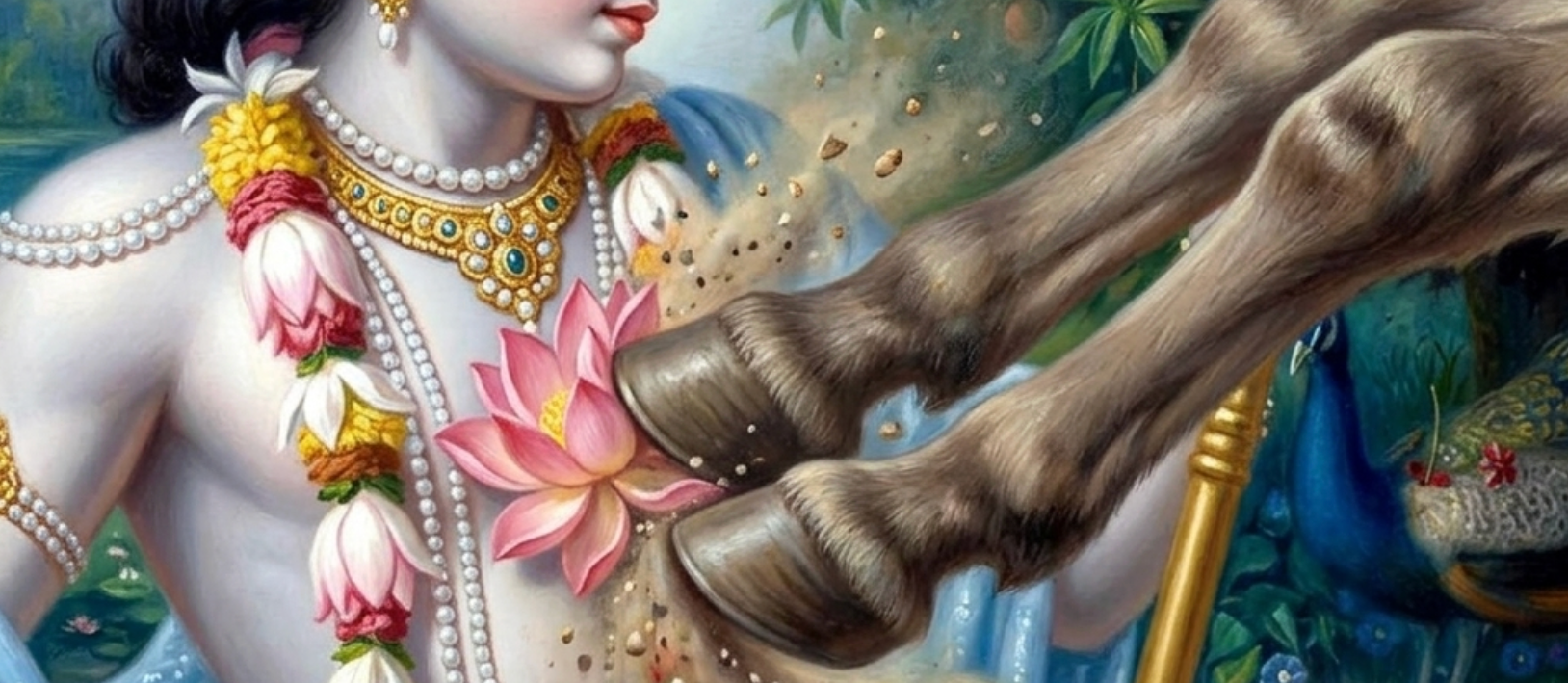
Those who engage in this asinity—whether professing themselves as Mādhva or Gauḍīya—embody one or the other of Dhenukāsura’s two legs, which he used to kick Baladeva in the chest and then ran about braying, trying to find another opportunity to kick Him. This pattern of behavior perfectly fits that of those trying to divide the Mādhva and Gauḍīya lineages. They have sealed their own fate by raising their filthy hooves and kicking the personification of the one indivisible guru-tattva, Śrī Baladeva, in the chest with their inauspicious ungula.
The Source of the Confusion: Structural Taxonomy
The misunderstanding stems primarily from how Madhvācārya outlines his cosmic hierarchy (tāratamya) in works like the Mahābhārata-tātparya-nirṇaya. Operating from what can be termed a “Purāṇic Paradigm,” Madhva is a rigorous taxonomist, as the demand of his era was to build a defensive, highly logical framework (tattva-vāda) to establish the absolute reality of difference (bheda) and the total supremacy of Viṣṇu (viṣṇu-sarvottamatva) against impersonalism. To make his philosophy bulletproof, he had to adhere strictly to the literal, external Purāṇic taxonomy.
He relies heavily on Purāṇic narratives where Balarāma acts within the material realm, expresses human-like bewilderment, and is explicitly identified as an incarnation of the cosmic serpent, Ādi-Śeṣa. Because Śeṣa, according to Madhva’s hierarchy, occupies a specific subordinate tier (kakṣa) within the dependent class (paratantra-tattva), the biased readers hastily conclude that Madhva views Baladeva as a mere conditioned entity, distinct from the supreme essence of Lord Hari.
Madhva explores this structural taxonomy further in Mahābhārata-tātparya-nirṇaya Chapter 22, verses 243–247, which analyze the martial training and mace duels between Bhīma (the incarnation of Vāyu/Mukhya Prāṇa) and Balarāma. In Madhva’s hierarchy, Vāyu is the highest of all individual souls (jīvottama), naturally outranking Śeṣa. Madhvācārya explicitly clarifies the mechanics of their engagements in verses 245–247: Balarāma functions as a vivid manifestation of Godhead because He carries the direct āveśa of Lord Acyuta. Whenever this direct āveśa of the Supreme Lord is actively manifest, Balarāma emerges victorious. Crucially, the text notes that during their mock duels, Bhīma restrains his true power and willingly yields to Balarāma out of profound devotion, because he recognizes the immediate presentation of his Supreme Master within his teacher. This demonstrates that Balarāma is never viewed as an ordinary soul, but as an instrument completely infused with Godhead.
While the Gauḍīyas quickly invert this incarnational chain of Śeṣa to Balarāma—“śeṣas ca yasyāṁśa-kalāḥ sa nityānandākhya-rāmaḥ […that Rāma known as Nityānanda, whose plenary portional part is Śeṣa…]” (Cc. Ādi 1.7)—for Madhva to casually classify Balarāma as an aṁśa of Śeṣa is not irremediably contradictory to Gauḍīya theology. For one, the scriptural references, Madhva relies on in his commentaries to establish Balarāma’s identity as an aṁśa of Śeṣa retain an element of suggestive ambiguity as in “śeṣāṃśāḥ prakīrtitāḥ,” which translates to “celebrated as,” “proclaimed to be,” or “popularly rumored as.” By relying on such flexible phrasing, Madhvācārya masterfully preserves the structural rules of his Purāṇic paradigm while leaving the internal, esoteric gate wide open for his Gauḍīya successors to fully unpack the infinite tattva of Lord Baladeva.
Madhva’s Resolution of the So-called Contradiction
Beyond the textual nuance of prakīrtitāḥ, Madhva provides ample, clear resolution to this so-called contradiction via the whole of his aforementioned commentary on Śrīmad-Bhāgavatam (4.16.19). Here, Madhva addresses the paradox of how a seemingly finite container can manifest absolute divinity. Here is the verse and Madhva’s commentary in full with its English translation:
ayaṁ tu sākṣād bhagavāṁs try-adhīśaḥ
kūṭa-stha ātmā kalayāvatīrṇaḥ
yasminn avidyā-racitaṁ nirarthakaṁ
paśyanti nānātvam api pratītam
Śrīmad-Bhāgavatam 4.16.19
This King [referring to King Pṛthu] is the master of the three worlds, and He is directly empowered by the Supreme Personality of Godhead. He is without change, and as the Supersoul, He has descended through a partial plenary expansion. In Him, people observe no material variegatedness or duality, for they recognize that such distinctions are simply the meaningless creations of material illusion.
madhva—
tatra sannihitaḥ sākṣād-bhagavān |
brahmaṇyante garuḍe rudre kāme śacīpatau |
aniruddhe mano caiva pṛthau ca kṛtavīryaje ||
nārade caivam-ādyeṣu viśeṣāt sannidhir hareḥ |
sudarśanādiṣv-astreṣu tathā sannihito hariḥ |
nara-lakṣmaṇau balaś-caiva śeṣāṃśāḥ prakīrtitāḥ ||
tathābharata-śatrughnau cakra-śaṅkhāvudāhṛtau |
pradyumnaśca kumāraśca skandaḥ kāmāṃśajāḥ smṛtāḥ || iti skānde |
vainye pṛthau sannihito rājarūpī janārdanaḥ | iti brāhme |
yal-loke nirarthakaṃ tad-bhagavad-rūpeṣu
pratīta-nānātva-dṛṣṭāntena paśyanti santaḥ |
matsyarūpādi-nānātva-dṛṣṭivad-yan-nirarthakam iti pādme |
evaṃ dharmān pṛthak paśyantiti ca ||
Śrī Madhvācāryā’s commentary:
There, the Supreme Lord Himself is directly present (sannihitaḥ): within Brahmā, in Garūḍa, Rudra (Śiva), Kāma (the god of love), and Śacīpati (Indra), as well as in Aniruddha, Manu, Pṛthu, and Kārtavīrya (the son of Kṛtavīrya). And in Nārada and other primal figures, there is a special presence (viśeṣāt sannidhiḥ) of Lord Hari. Similarly, Lord Hari is present within divine weapons such as the Sudarśana disc and others. Nara [of the Nara-Nārāyaṇa Ṛṣis], Lakṣmaṇa, and Balarāma are celebrated as expansions (aṁśas) of Śeṣa. In the same manner, Bharata and Śatrughna are stated to be expansions of Hari’s Discus (cakra) and the Conch (śaṅkha). Pradyumna, Sanat-kumāra, and Skanda (Kārtikeya) are remembered as being born from the parts of Kāma.
Thus ends the quote from the Skanda Purāṇa.
Lord Janardana (Vishnu) is specially present (sannihitaḥ) in King Pṛthu, the son of Vena, appearing in the form of a king. Thus ends the quote from the Brahma Purāṇa.
That which is meaningless in the material world is seen by saintly persons through the example of the perceived diversity among the diverse forms of the Supreme Lord. That [material diversity] is as meaningless as viewing variety [or separation] in forms like Matsya-avatāra and others. Thus ends the quote from the Padma Purana.
And in this way, they see the spiritual attributes as separate.
As one can see above, Śrī Madhvācārya first quotes the Skanda Purāṇa to satisfy his structural taxonomy: “Nara, Lakṣmaṇa, and Balarāma are celebrated as expansions (aṁśas) of Śeṣa.” But he does not stop there. He immediately invokes the principle of viśeṣāt sannidhir hareḥ—the supreme, direct, and unmediated presence of Lord Hari Himself within that form. And to ensure the reader does not mistake this “presence” for a temporary or partial empowerment, Madhva seals his commentary with a profound quote from the Padma Purāṇa: “That [material diversity] is as meaningless as viewing variety [or separation] in forms like Matsya-avatāra and others.”
The logic here is airtight and devastating to the sectarian view. Madhvācārya explicitly states that viewing any separation or material variety (nānātva) within the form of Baladeva is a pointless spiritual blunder (nirarthakam). Just as Viṣṇu’s Matsya, Kūrma, and Varāha incarnations are identical in essence as the single, undivided Supreme Personality of Godhead, the direct presence of Hari within Baladeva makes Him ontologically identical to the Supreme Lord.
Clarification in Bhāgavata-tātparya-nirṇaya
The definitive refutation of this “mere jīva” myth is found directly within Madhvācārya’s commentary on the emperor of verses, Śrīmad-Bhāgavatam (1.3.28)—“ete cāṁśa-kalāḥ puṁsaḥ kṛṣṇas tu bhagavān svayam.” In his Bhāgavata-tātparya-nirṇaya, Madhva draws an indelible boundary between individual souls and divine incarnations, while explicitly highlighting Kṛṣṇa’s primal position:
ete proktāḥ avatārāḥ mūla-rūpī kṛṣṇa-svayam-eva |
jīvās tat-pratibimbāṁśā varāhadyāḥ svayaṃ hariḥ |
dṛśyate bahudhā viṣṇur aiśvaryādika eva tu |
“Of all these aforementioned incarnations, Kṛṣṇa alone is the original root-form Himself. Individual souls (jīvas) are merely His reflection-like parts (pratibimbāṁśa), whereas incarnations like Varāha and others are directly Lord Hari Himself. Lord Viṣṇu manifests in multiple ways solely to exhibit His supreme majesty (aiśvarya) and other divine attributes.”
ete proktāḥ avatārāḥ – “Of all these aforementioned incarnations...” (This acts as a genitive/locative of selection, defining the group being discussed).
mūla-rūpī: “...the one who possesses the original/root form...”
kṛṣṇa-svayam-eva: “...is Kṛṣṇa Himself alone.” (The particle eva creates an absolute restriction: alone or exclusively.)
Here, Madhvācārya leaves no room for ambiguity. He categorizes the jīvas as dependent reflections (pratibimbāṁśa), while explicitly distinguishing the avatāras as directly Lord Hari Himself and Kṛṣṇa as the original form of Godhead. Most brilliantly, by using the term mūla-rūpī exclusively for Kṛṣṇa, Madhva establishes that Kṛṣṇa is the unique fountainhead of the divine expansions—a realization that perfectly anticipates the core of Gauḍīya theology.
Two Perspectives, One Truth
When we look past the surface terminology, we find that the Tattvavādī and Gauḍīya paradigms are looking at the exact same divine phenomenon through different focal lengths. Madhva’s focus is more structural. To preserve the narrative framework of the Purāṇas and protect the absolute perfection of Viṣṇu (viṣṇu-sarvottamatva), Madhva identifies the outer external lineage—Baladeva manifests via the line of Śeṣa. The Gauḍīyas, on the other hand, hone in on the indivisibility, or akhaṇḍatva. Utilizing acintya-bhedābheda (inconceivable oneness and difference), the Gauḍīya Ācāryas focus on the internal reality. Because the content of Baladeva is the absolute, undivided Svayam Bhagavān, they declare Him to be non-different from Kṛṣṇa.
This is not a theological divergence; it is an inversion of cause and effect. While the Purāṇic paradigm tracks the “descent” of Godhead downwards into the material creation, the Gauḍīya esoteric paradigm tracks it upwards into the spiritual sky (Goloka), where Śeṣa himself is understood to be a tiny ray emanating from the original spiritual form of Baladeva.
Conclusion: Overcoming the Impulse to Separate
The sectarian impulse to find irreconcilable differences between Śrī Madhvācārya and the Gauḍīya lineage often relies on isolating words and twisting their interpretation while ignoring broader context. When less-informed practitioners thus split hairs, or hooves, and weaponize terminology to split these sampradāyas apart, they ignore the profound harmony engineered by the Ācāryas.
Madhva’s warning against seeing nānātva (separation) in the Lord’s forms remains a timeless reminder: when looking at Lord Baladeva, to see anything less than the direct majesty of the Supreme Lord is to fall into the very illusion the Ācāryas fought to dismantle.