Airbenders Real and Apparent

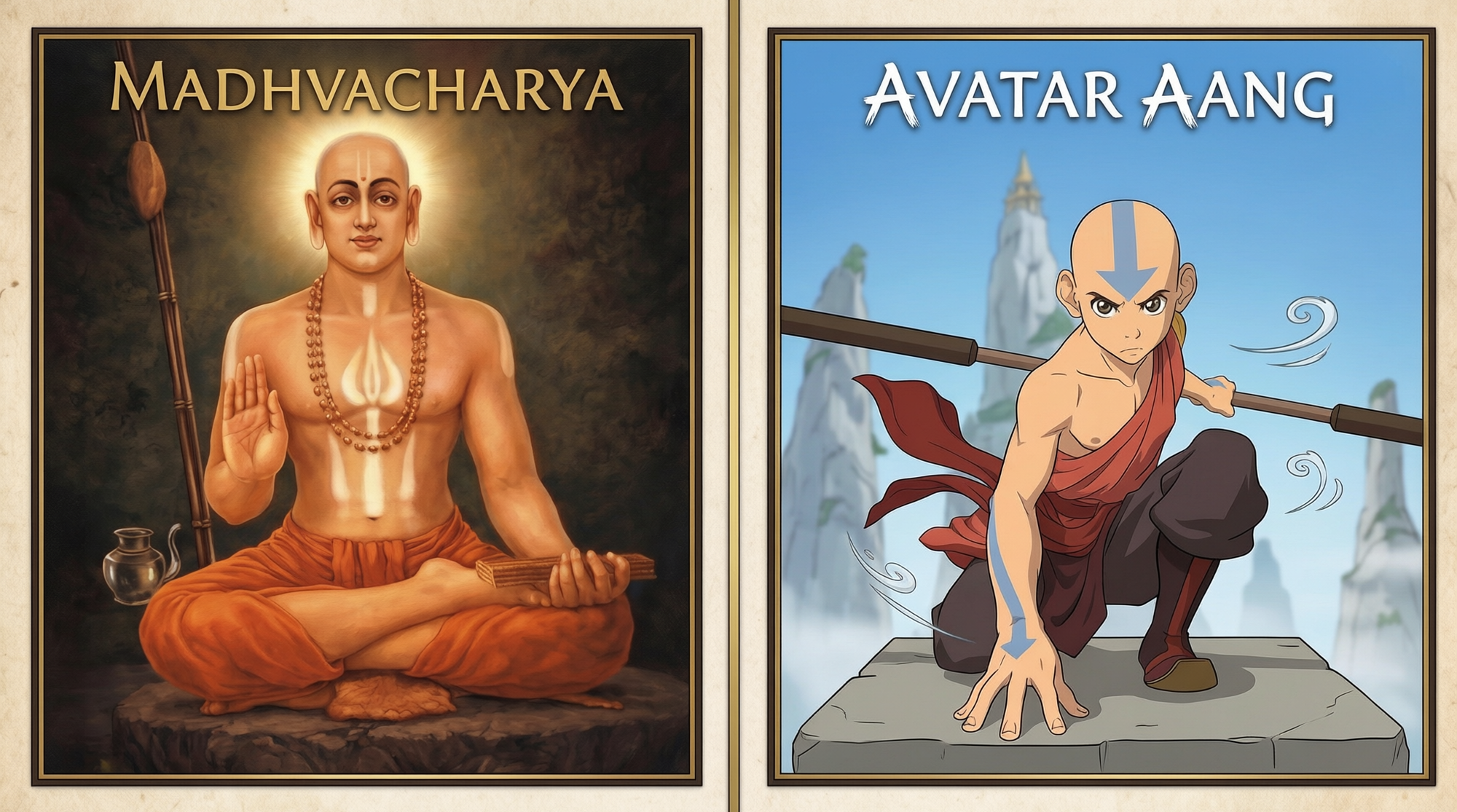
The Uncanny Parallels Between Aang and Śrī Madhvācārya
Netflix recently released its second season of their live-action rendition of Avatar: The Last Airbender, a popular animated series created by Michael Dante DiMartino and Bryan Konietzko, who drew heavily from Tibetan Buddhism, Shaolin kung fu, and generalized Hindu concepts. Anyone familiar with the 13th-century philosopher-saint Śrī Madhvācārya, a real-world historical figure, will notice how the character and story of Avatar Aang closely mirrors Mādhva lore.
The Incarnation of the Wind
In the Dvaita tradition, Madhvācārya is explicitly revered as the third and final earthly incarnation of Vāyu, the Vedic god of wind (following Hanumān and Bhīma). He is thus considered the last “airbending” avatāra born to restore spiritual balance to the world by preaching the absolute, real distinction between the soul and the Divine.
Aang fulfills a similar cosmic role in a long line of “avatāras” who have special mastery over the physical elements and protect mankind from malevolent forces. Aang is born in a tribe of “Air Nomads” who are mostly monks and becomes an expert “airbender” at an early age. However, his tribe is annihilated by the Fire Nation while he alone survives a hundred years, trapped in a ball of ice.
The Monk, the Staff, and the Mark
Visually, the iconography of Madhvācārya is instantly recognizable to any Avatar fan. Upon taking his ascetic (sannyāsa) vows, Madhvācārya adopted the traditional daṇḍa—a monastic wooden staff. His primary biography, the Sumadhva-vijaya, documents his legendary physical strength and fighting expertise, detailing encounters with dacoits, tigers, and hostile armies.
Furthermore, Madhvācārya and his followers wear a distinct tilaka mark on their foreheads using sacred white clay (gopī-candana) and incense ash. This vertical geometric marking, running down the center of a shaved head, serves as a striking real-world echo to the sacred arrow tattooed onto the foreheads of Air Nomad monks to denote their mastery of spiritual energy.
Persecution of the Lineage
A central plot point in Avatar is the tragic extermination of the Air Nomads by the Fire Nation, leaving Aang to revive a lost spiritual tradition. Similarly, as detailed in the Maṇi-mañjarī, the prelude to the Sumadhva-vijaya, Madhvācārya’s predecessors were violently persecuted by Śaṅkarācārya’s followers and all but exterminated, forcing one surviving Vaiṣṇava to live among the Māyāvādīs and pass on his mantra tradition in secret. This covert survival operation carried on for about four centuries, for one master to another, till the time of Madhva, who finally brought a devastating challenge to the monolithic Advaita school.
Historical texts like the Sumadhva-Vijaya record accounts of Madhvācārya’s followers being persecuted, his monasteries targeted, and his library of sacred texts stolen and buried in an attempt to erase his teachings. Like Aang, Madhva had to rebuild his lineage from the ground up against overwhelming ideological and physical opposition.
The Deity in the Clay, The Boy in the Iceberg
Another parallel lies in the foundational miracles of both figures. In the premiere episode of Avatar, Aang is discovered frozen inside a glowing sphere of ice, preserved for a century until he is awakened to bring balance to the world.
Madhvācārya, on the other hand, experienced his own legendary “awakening” moment by the ocean in Malpe. One day, as he sat meditating on the beach, he saw a ship run aground on a hidden shoal. Madhva used his yogic mastery over his prāṇa (life airs) to channel a tremendous amount of strength and singlehandedly dislodge the ship. In gratitude, the captain of the ship offered him anything from the cargo. Madhva chose a massive lump of gopī-candana (sacred clay) used as a ballast. When Madhva broke open the heavy chunk of earth, he discovered hidden inside it the ancient, beautiful deity of Nṛtya-gopāla (the dancing child form of Kṛṣṇa).
In Avatar, the world’s hope was encapsulated in a block of ice waiting for the right moment to be revealed, and in the Mādhva tradition, their central deity was perfectly preserved within a dense block of clay, waiting for the master of the wind to crack it open and initiate their powerful ongoing current of devout worship.
Archetypes Across Time
While the creators of Avatar arrived at these concepts through a synthesis of universal storytelling archetypes, the overlap remains uncanny. Whether by cosmic coincidence or the timeless repetition of heroic myth, the legendary journey of the Last Airbender was already lived out centuries ago on the shores of medieval India by a real master of the wind.
The Metaphysics of Oppression: The Real vs. The Apparent
When Śrī Madhvācārya stepped onto the philosophical stage, the intellectual landscape was utterly dominated by the Advaita Vedānta school of Ādi Śaṅkara. Advaita posits a radical monism: ultimate reality (Brahman) is a singular, undifferentiated, monolithic whole. In this view, the material world, individual souls, and all perceived differences are ultimately mithya: an illusion, a mere apparent reality manufactured by ignorance (Māyā). To Advaita, diversity is a lower stage of truth that must eventually dissolve into the One.
Madhvācārya’s Dvaita philosophy was a revolutionary rebellion against this concept. He argued for Tattvavāda, the philosophy of reality. To Madhva, the world is not an illusion; it is absolutely real. Individual souls are eternally distinct from one another, and eternally distinct from God. Difference is not a flaw to be dissolved; it is the fundamental nature of existence.
This exact metaphysical clash forms the hidden ideological engine of Avatar: The Last Airbender.
PHILOSOPHICAL & THEMATIC COMPARISON
──────────────────────────────────────────────
│ ADVAITA VEDANTA / THE FIRE NATION
• Monolithic Unity: “All is one / All must be Fire”
• Apparent Reality: Suppression of unique identities
• Dissolution: Erasing boundaries by force
───────────────────────────────────────────────
│ DVAITA VEDANTA / THE AVATAR
• Eternal Distinction: The Four distinct Nations
• Absolute Reality: Material world & balance matter
• Pluralism: Preserving individual cultural truths
───────────────────────────────────────────────
The Fire Nation as the Monolithic “One”
Fire Lord Sozin’s imperialist campaign is the political manifestation of a forced, distorted Monism. When Sozin states that the Fire Nation wants to “share our greatness with the world” by uniting everyone under a single global empire, he is attempting to forcibly erase diversity.
Under Fire Nation rule, there is no room for the distinct identities of the Water Tribes or the Earth Kingdom. Earthbenders are stripped of their element and caged on iron ships; Air Nomads are utterly wiped out. The Fire Nation treats the unique cultural and spiritual boundaries of the world as merely apparent obstacles that must be melted away into a singular, monolithic, totalitarian whole. Fire is the absolute, and everything else must dissolve into its flame.
Madhvācārya and Aang: Champions of the Real
In stark contrast, Aang’s cosmic duty as the Avatar is fundamentally a Dvaita mission. The Avatar’s purpose is to maintain Balance—a balance that can only exist if the four nations remain fiercely, beautifully, and eternally distinct.
Just as Madhvācārya fought the intellectual elite of his day to prove that individual souls retain their unique identity even in liberation, Aang fights to ensure that the Air, Water, Earth, and Fire nations retain their sovereign, independent realities. For both Aang and Madhva, the physical world and its diverse expressions are too real, too sacred, to be swallowed up by a monolithic power.
When the Śāṅkaraites targeted Madhvācārya, stealing his texts and attempting to intellectually and physically homogenize the spiritual landscape, they acted out the same impulse as the Fire Nation: the desire to see a complex, pluralistic world reduced to a single, undifferentiated state. By standing as a “master of the wind” wielding a staff to protect his followers, Madhvācārya wasn’t just defending people; he was defending the reality of difference against the crushing weight of a monolithic illusion.
Ultimately, Aang and Madhva both prove that true spiritual mastery does not look down upon the material world as an illusion. Instead, it steps directly into the arena of the Real to defend the unique, individual expressions of life from being extinguished.