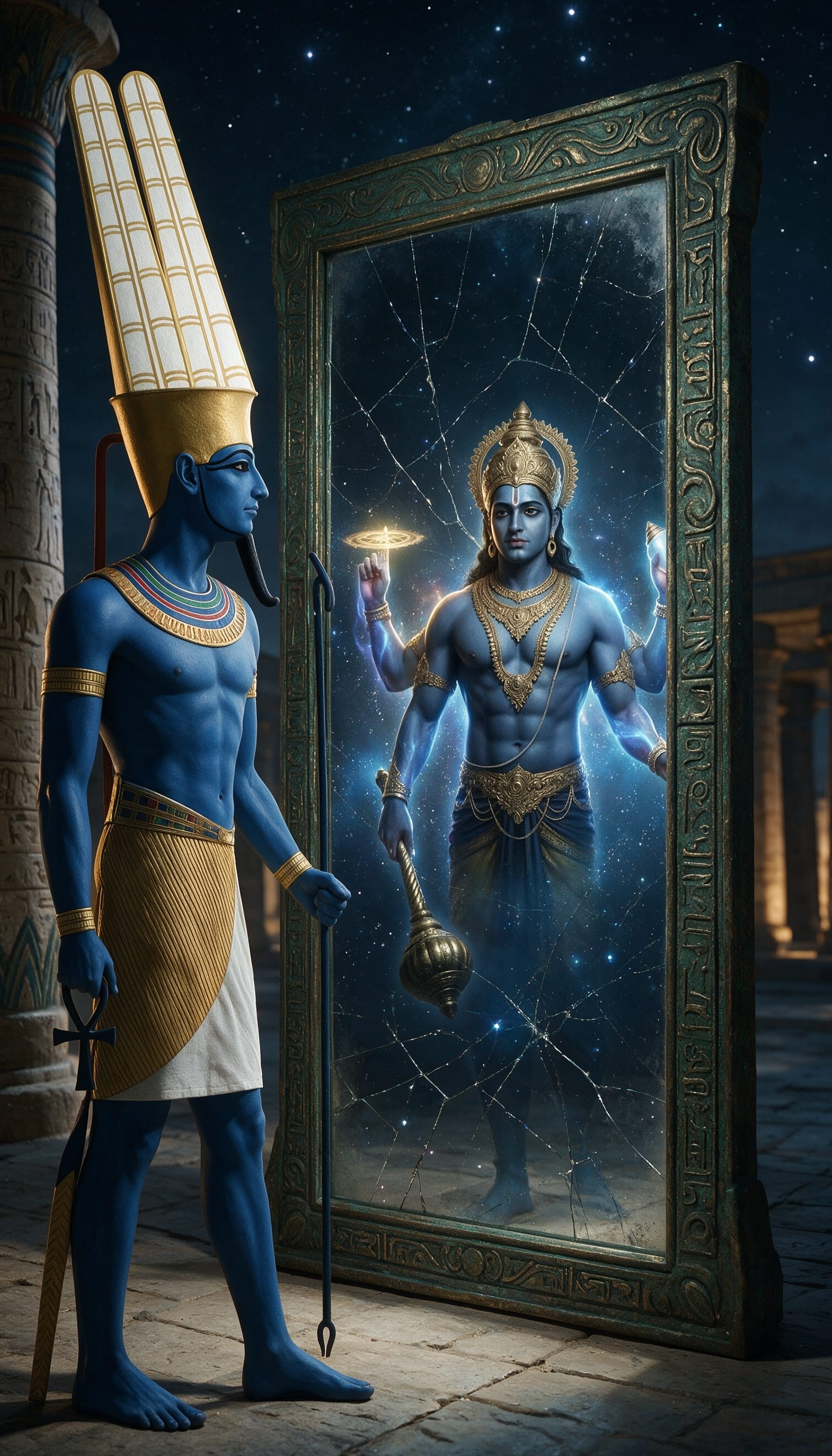
The Fractured Mirror: Why the Parallels Between Ancient Egypt and Vedic Culture Prove a Shared Primordial Source

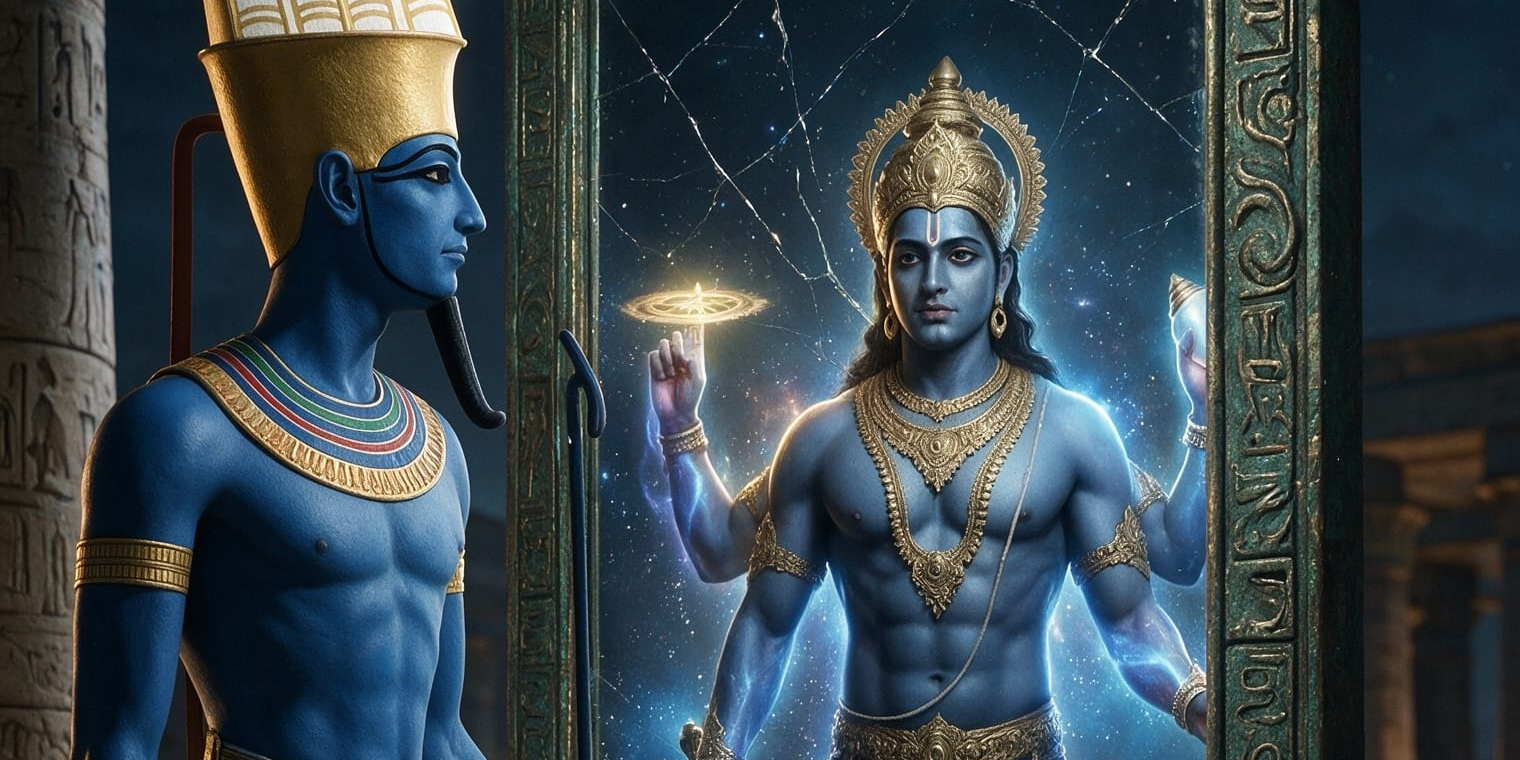
For centuries, historians, linguists, and theologians have been captivated by the striking parallels found between the ancient civilizations of the Nile Valley and the Gangetic plains. The symbolic and metaphysical overlaps between their paramount deities, namely Egypt's Amun-Ra and India's Viṣṇu, are too profound to be dismissed as mere coincidence. Both are depicted with blue skin signifying cosmic pervasiveness; both command primordial, multi-headed serpents (Kematef and Śeṣa-nāga) floating upon the causal waters of creation; and both represent a highly sophisticated, non-dual theology where a hidden, unmanifest or transcendental absolute manifests as an all-sustaining personal savior.
In modern comparative mythology debates, these similarities have led to a polarization of ideas. While mainstream secular academia often dismisses these parallels as independent psychological archetypes, a faction of alternative historians assert that Egyptian culture is the direct origin of the Vedic tradition. However, an objective examination of historical linguistics, ancient DNA, and traditional Puranic chronology reveals a much deeper truth: Egypt did not birth the Vedas, and the Vedas did not birth Egyptian culture—at least not culturally, linguistically, or ethnically. To clarify, while the historical Vedic culture did not birth Egyptian culture, the primordial Veda—defined as the singular, timeless knowledge of reality—absolutely did birth the Egyptian world. Egypt and historical India represent two parallel regional fragmentations of a singular, highly advanced, global Satya-yuga source rooted entirely in that original Vedic knowledge.
The Scientific Refutation of "Egypt-First"
To assert that Egyptian culture is the source of the Vedic world is to fundamentally misunderstand the structural boundaries of anthropology and linguistics. If the Vedic tradition were a derivative of the Nile Valley culture, its traces would be indelibly stamped into the foundational layers of Indo-Aryan society. They are not.
Linguistically, ancient Egyptian belongs to the Afroasiatic language family, whereas Sanskrit is a core branch of the Indo-European family. Their underlying grammatical frameworks and core vocabularies share absolutely no common ancestry. It is a linguistic impossibility for Sanskrit to have evolved from Egyptian. Furthermore, archaeogenetics and ancient DNA (aDNA) mapping have tracked the distinct migrations of the western Eurasian genetic components (such as the R1a haplogroup) associated with early Indo-Iranian peoples; this genetic signature has no ancestral footprint in the ancient Nile Valley populations.
Finally, the ritual cultures are distinct, bound to entirely different landscapes. Egyptian ritualism is deeply chthonic (relating to or inhabiting the underworld), obsessed with localized geography, the annual flooding of the Nile, and the preservation of the physical corpse via mummification. The Vedic system, by stark contrast, focuses on the "aboveworld," on fire rituals (yajña), cosmic order (ṛta), and celestial sky-deities. There are no pyramids, scarab beetles, or Nile references in the oldest layers of the Ṛg-veda. The two systems are structurally independent.
The Chronological Puzzle: A Parallel Dawn
When we peel back the layers of time to find the origins of these traditions, we do not find one predating the other; more astonishingly and significantly, however, we find them emerging concurrently in a synchronized global epoch. Mainstream historical linguistics and genetics place the undivided ancestral group of the Indo-European family, the Proto-Indo-Anatolian complex, around the 5th to 4th millennium BCE (c. 4500–4000 BCE). This is the exact same window in which the earliest iterations of organized Egyptian culture were flourishing. Long before the dynastic pharaohs, the prehistoric Badarian and Naqada I cultures of the Nile were already practicing sophisticated agriculture, advanced craftsmanship, and complex religious symbolism.
Even further back, in the 8th millennium BCE, the Neolithic cattle-worshipers of Nabta Playa in southern Egypt were constructing the oldest known astronomical stone circles on Earth. This parallel dawn indicates that the deep roots of both cultures were growing at the exact same time in human prehistory, completely isolated from one another by thousands of miles of impassable terrain and ocean.
Cousins from a Golden Age
If there was no physical contact, no linguistic borrowing, and no genetic crossover, how do we explain the blue skin of Vishnu and Amun-Ra? How do we explain the identical metaphysics of the transcendental absolute (Paravyoma-nāyaka Śrī Nārāyaṇa / Amun, "The Hidden One") becoming the manifest light and savior of the universe (the Puruṣavatāra Viṣṇus / Ra)?
The answer lies in aligning these physical discoveries with traditional Puranic cosmology. In the Śrīmad Bhāgavatam (9.14.48), it is stated: "eka eva purā vedaḥ praṇavaḥ sarva-vāṅmayaḥ"—in the primordial Golden Age (Satya-yuga), there was only one un-fragmented Veda, a singular spiritual culture, and humanity belonged to a single, undivided social class (Haṁsa). The linguistic concept of a unified Proto-Indo-European ancestral language existing before it fractured into Sanskrit, Hittite, Latin, and Greek is the physical, academic evidence of this Satya-yuga reality. During this primordial epoch, a highly advanced cosmic metaphysics was globally understood. Society was fluid, lacking the rigid, hereditary caste systems that would later develop as humanity spiritually degenerated.
When the global Satya-yuga epoch faded and the Yuga cycles progressed, this unified primordial culture began to fracture and migrate. As tribes separated, they carried the memory of the same cosmic blueprint in their minds, adapting it to their new geographic realities. The priestly classes along the Nile preserved the memory of the blue-skinned cosmic sustainer as Amun-Ra, while the sages of the Gangetic plains preserved it as Vishnu.
The Proof in the Earth: Ammonite/Śāligrāma
This shared cognitive blueprint is tangible in the bosom of the earth itself, through the cross-cultural reverence of the ammonite fossil, or śāligrāma-śīlā. To the Egyptian world, these coiled, spiral marine shells were sacred symbols of the ram-horned god Amun. Later, the Greeks and Romans identified Amun with Zeus/Jupiter and revered these fossils as well. Thousands of miles away in the Indian subcontinent, the exact same fossilized spirals have been enshrined for millennia as the non-anthropomorphic, self-manifested form of Viṣṇu. That two entirely isolated civilizations would look at the exact same geometry in stone and independently assign it to their respective blue-skinned, all-pervading supreme creators is not a product of cultural plagiarism. It is the physical proof that both lineages were operating from the exact same inherited primordial memory.
The "Cattle Cults" of Egypt and India
This primordial synchronization is explicitly manifested in the dawn of animal veneration. Long before dynastic Egypt emerged, the Neolithic sages of Nabta Playa (c. 6000 BCE) were tracking the heavens using the world’s oldest megalithic stone circles, while simultaneously interring whole cows in elaborate, structurally protected subterranean sanctuaries. This prehistoric African "Cattle Cult" aligns flawlessly with the timeless Vedic reverence for go-mātā, or Mother Cow. In both geographically isolated traditions, the cow was an earthly manifestation of cosmic nourishment. The presence of identical pastoral metaphysics at the root of both lineages shatters the narrative of cultural plagiarism, revealing instead a universally distributed primordial memory of the living cosmos.
The Worship of the Paradoxical Mother
Nowhere is this primordial unity more esoterically profound than in the cosmic paradox of the Egyptian Goddess Hathor, who is celebrated as the mother of Horus and Ra. She is the celestial Sky-Cow who birthed the sun god Ra, the protective "Eye" of the supreme, and she also becomes the fierce lioness Sekhmet who destroys cosmic corruption. Sekhmet becomes so intoxicated by the slaughter of cosmic offenders that she cannot stop, threatening to swallow the entire world. To save humanity, the gods must trick her by pouring thousands of jars of beer dyed red with ochre to look like blood; she drinks it, becomes intoxicated, and returns to her peaceful state.
This exact metaphysical drama is preserved in the Devī Mahātmyam, where the gentle universal mother manifests as Durgā, the rider of the lion, who unleashes the unstoppable, bloodthirsty fury of Kālī to destroy demonic forces. While Sekhmet is the lioness, Durga rides the lion; both represent absolute mastery over the raging, solar, and temporal forces of the material universe. That two ancient, geographically isolated cultures utilized the exact same sequence—a gentle cosmic mother transforming into a world-devouring lioness who must be ritually pacified to save creation—stands as definitive proof of a synchronized global dawn.
Goddess Hathor’s fluid identity perfectly mirrors the Vedic realizations of Mother Surabhi and the absolute non-duality of Hari-Hara. Surabhi is revered as containing all the Devas in her body and is thus the cosmic mother. She engenders the cosmic Ocean of Milk for Viṣṇu and births the eleven Rudras of Śiva. Hathor likewise synthesizes preservation and destruction within a singular divine lineage.
Horus-Ra and Hari-Hara
When the Egyptians conjoined these paradoxical forces into Ra-Horakhty (Horus-Ra), and when the Puranic sages beheld the split-form of Hari-Hara, they were expressing the exact same cosmic absolute: that the ultimate, unchanging source of reality and the dynamic, active protector of the universe are an inseparable singularity. The ultimate metaphysical convergence of the Egyptian and Vedic worlds manifests in this hyphenated, non-dual architecture of their supreme composite deities. Egypt’s Ra (the primordial solar source and fire-principle) mirrors Hara (Śiva, the cosmic fire of dissolution), while Horus (the active king and defender of order) perfectly mirrors Hari (Viṣṇu, the supreme preserver of Dharma). This structural identity proves that the high-level, non-dual theology of Viṣṇu and Śiva as co-eternal aspects of the Absolute Truth was globally understood during the Satya-yuga, fracturing into the complex visual pantheons of the Nile and the Ganges as the ages progressed.
Conclusion
All these similarities between Egypt and the Vedic world are proof of a shared inheritance. They are the fractured pieces of a prehistoric mirror that once reflected a spiritually unified world. By recognizing Egypt and the Vedic world as parallel regional fragmentations of a single primordial source, we escape the trap of ethnocentric "who came first" debates. We are left instead with a profound historical truth: at the very dawn of human memory, across completely different continents, humanity was drinking from the exact same well of cosmic wisdom.
Summary of Parallels
Theological & Cosmological Parallels
The Infinite Blue Complexion: Both Bhagavān Viṣṇu and Amun-Ra feature blue skin representing cosmic omnipresence and all-pervading space.
The Primeval Creation Serpent: Viṣṇu resting on Śeṣa-nāga upon the causal ocean mirrors Egypt's supreme deity as Kematef, the primeval serpent on the cosmic waters (Nu).
Transcendent Source vs. Cosmic Action: The unmanifest absolute (Paravyoma-nāyaka Śrī Nārāyaṇa / Amun, "The Hidden One") expanding into localized cosmic form (the Puruṣāvatāras / Ra, the visible solar light).
The Non-Dual Composite Deity: Hari-Hara (Viṣṇu the Preserver merged with Śiva the Destroyer) matches Horus-Ra (Horus the active kingly defender conjoined with Ra the solar source).
Pastoral & Feminine Energy Archetypes
Prehistoric Cattle Veneration: The Neolithic builders of Nabta Playa ritually burying intact cows parallels the timeless Vedic reverence for go-mātā.
The Universal Sky-Cow: The Goddess Hathor as Mehet-Weret (the celestial cow whose milk formed the heavens) mirrors Mother Surabhi, who generated the cosmic Ocean of Milk (Kṣīra-sāgara).
The Lioness: The precise narrative of a gentle mother goddess transforming into an unstoppable, blood-satiated lioness (Sekhmet / Ma Durgā & Kālī) to purge cosmic corruption.
Mastery Over the Beast: Durgā commanding her lion mount matches Sekhmet embodying the lioness; both represent absolute divine dominion over the raw, material forces of nature.
Physical & Geopolitical Markers
The Ammonite and the Śāligrāma: Coiled spiral fossils named ammonites after the ram-horned Egyptian Amun, while simultaneously enshrined in India as Śāligrāmas—the self-manifested form of Viṣṇu.
The Mitanni Treaty: Anatolian clay tablets (c. 1380 BCE) invoking Indra, Mitra, Varuṇa, and the Nāsatyas, proving the original Satya-yuga pantheon spanned the ancient Near East.