Does God Poop?

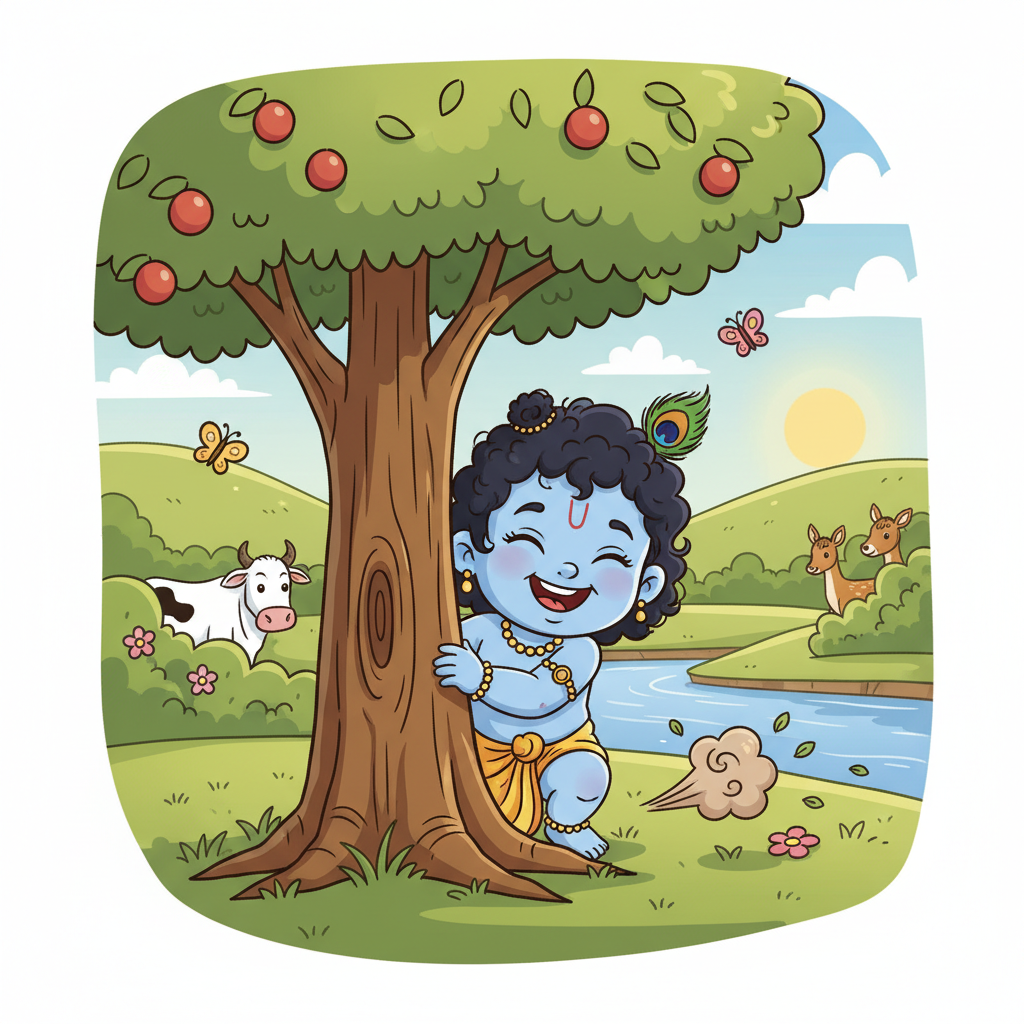
Is it blasphemous to wonder so? Evidently not, if one of our most illustrious ācāryas poses the question rather frankly. Vedāntācārya Śrīla Baladeva Vidyābhūṣaṇa wrote the Gauḍīya Vaiṣṇava commentary on Vedānta-sūtra that is known was the Govinda Bhāṣya. Later, he wrote Siddhānta-ratnam, a supplementary text, formally called a prolegomenon, to serve as a pīṭhakam, a throne or foundation, to the lengthy and celebrated bhāṣya. Toward the end of the first chapter, or “Pāñcajanya-pādaḥ,” of Siddhānta-ratnam (verses 62–65), he addresses as follows the undeniably amusing question of whether or not God might defecate:
It is possible that Bhagavān could have some connection with the heyāṁśa, or undigestible parts, of the rice, etc., that is lovingly offered by a devotee who has realized Bhagavān’s true power as the supreme enjoyer. While it is illogical to imagine such inferior, undesirable elements in forms like Śrī Nārāyaṇa, whose form is pure spiritual knowledge, one might think it possible in human-like forms such as that of Śrī Kṛṣṇa. After all, evidence to support such notions are found in the Tenth Canto of Śrīmad Bhāgavatam. In response to this pūrva-pakṣa-esque skepticism, the supernatural nature of the objects enjoyed by the Lord is to be explained here. Everything enjoyed by the Lord is svarūpa-śakti-rasātmaka, or composed of the essence of His internal potency. As confirmed in the Brahma-saṁhitā, the Vraja-devī beloveds (of Kṛṣṇa) are goddesses of fortune, their kānta (lover) is the Supreme Person Śrī Kṛṣṇa who is playing as a cowherd boy, the trees are celestial desire-trees, the earth is made of wish-fulfilling gems, the water is nectar, every word is a song, every movement is a dance, the flute is a dear friend, the sun, moon, and other luminaries are composed of transcendental bliss, and all other objects of His (the Lord’s) enjoyment are of the like. The Hayaśīrṣa Pañcarātra also affirms: “In the divine realms of Vaikuṇṭha, the objects of the Lord’s enjoyment are pure rasa (spiritual essence). They lack inferior parts like skin or seeds; they are non-material, spiritual substances. They do not merely possess flavor like material goods; they are the personifications of spiritual flavor, or rasa, itself. (62)
There are no inferior, rejectable aspects [to spiritual objects]. However, one might say that those who worship the Lord in His human-like form as Śrī Kṛṣṇa may repeatedly feed Him, etc., and then entertain some apprehension about the inferior aspects of what He has eaten, etc. This [any chance of the excretion of waste] is also impossible. For when all the objects enjoyed by the forms of spiritual bliss like Śrīman Nanda and Yaśodā are themselves non-material, and their (Śrīman Nanda and Yaśodā's) perception of those various objects is also of that nature, then such an apprehension of inferior aspects, or bodily waste products, is not even possible. The great soul Kavi Karṇapūra has also affirmed this: “In the capital of the King of the Gopas, the word ‘mala’ (filth) is heard only in the word ‘parimala’ (fragrance), not elsewhere; the word ‘bandha’ is heard only in the words ‘nīvi-bandha’ (waistband knot) and ‘keśa-bandha’ (hair tie), not elsewhere. Due to the absence of stool, urine, etc., the transcendental nature of all things there is established.” (63)
In the verse beginning “evaṁ dhṛṣṭatām aśati kurute mehanādīni vāsto,” (Śrīmad Bhāgavatam 10.8.31) where it is generally thought Śrī Kṛṣṇa's stool and urine are being mentioned, that must also be reconciled by giving another meaning in order to preserve the true, intended sense. In that context, “mehanādīni” refers to sprinkling water and throwing dust, etc. The root ‘mih’ has the meaning of sprinkling, as is well known in the word ‘megha’ (cloud). Alternatively, by splitting the words as “amā iha nādīni,” a different meaning can also be derived. (64)
Similarly, whatever bodily waste products are mentioned in the case of Ṛṣabhadeva should be understood as merely a description of how they were perceived by ignorant people. Otherwise, such inferior aspects are impossible in a spiritual body. In that context, the application of the words “devamāyā-vimohitāḥ” (bewildered by the Lord's illusory energy) clearly indicates the perception of the ignorant by the merciful Ṛṣi. By the statement “idaṁ śarīraṁ mama durvibhāvyam” (this body of Mine is incomprehensible), Ṛṣabhadeva Himself has also concluded the same thing. Moreover, when it is stated that even the perfected living entities who served Him were devoid of any connection with inferior aspects, then what to speak of Him? It is stated in the Smṛti: “Those devotees of the Lord, whose hearing and chanting destroys the impurities of people in general, who are devoid of stool and urine, they alone are said to be of holy fame.” (65)
So, the short answer is: No, God does not poop. Why? Because He only eats of the purest kinds of love, and such pristine love, in all its forms—even as food and drink offered by His loving associates and devotees—has no rejectable or nonabsorbable aspects.